
Honda CR-V: Calculating Fuel Economy
Measuring Techniques
Direct calculation is the recommended source of information about your actual fuel economy.
Using frequency of fill-ups or taking fuel gauge readings are NOT accurate measures of fuel economy.
Fuel economy may improve over the first several thousand miles (kilometers).
Checking Your Fuel Economy
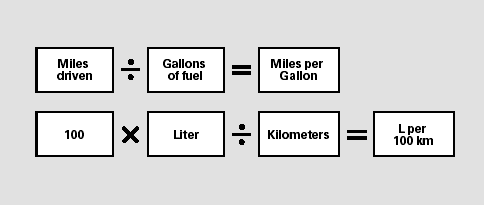
1) Fill the fuel tank until the nozzle automatically clicks off.
2) Reset trip counter to zero.
3) Record the total gallons (liters) needed to refill.
4) Follow one of the simple calculations above.
READ NEXT:
 Accessories and Modifications
Modifying your vehicle, or installing
some non-Honda accessories, can
make it unsafe. Before you make any
modifications or add any accessories,
be sure to read the following
information.
Accessories
Your dealer has Honda accessories
that allow you to personalize your
vehicle. These accessories have
been designed and approved for your
vehicle, and are covered by warranty.
Although non-Hon
Modifying Your Vehicle
Removing parts from your vehicle,
or replacing components, with
non-Honda components could
seriously affect your vehicle’s
handling, stability, and reliability.
Here are some examples:
Low
SEE MORE:
Connecting Rod Bearing Replacement
Rod Bearing Clearance Inspection
1. Remove the oil pump.
2. Remove the baffle plates (see step 7).
3. Remove the connecting rod cap and bearing half.
4. Clean the crankshaft rod journal and bearing half
with a clean shop towel.
5. Place plastigage across the rod journal.
6. Reinstall the bearin
Phone Setup
This command group is available for
paired cell phones.
Phone pairing tips
You cannot pair your phone while
the vehicle is moving.
Your phone must be in discovery
or search mode to pair. Refer to
your phone’s manual.
Up to six phones can be paired.
Your phone’s battery may drain
f
© 2016-2026 Copyright www.hcrv.net
